Understand Wallpaper Pattern Repeat Before You Calculate
Distinguish repeat length from match type and see why both affect wallpaper cutting and quantity.
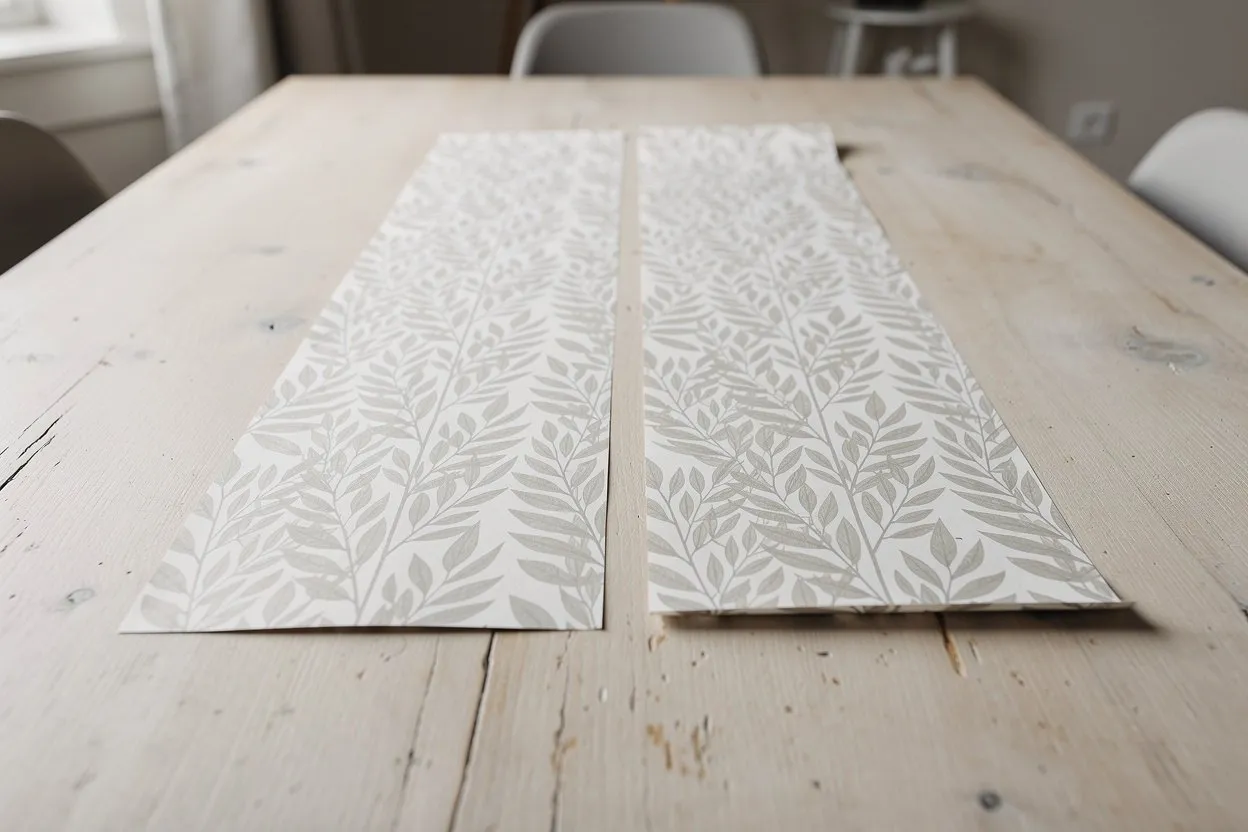
The pattern repeat is the distance before a design repeats along the wallpaper. The match type describes how adjacent strips line up. These are related details, but they are not the same input. A quantity estimate that knows the repeat length but ignores the match instructions can still be wrong. Read the label or product specification before selecting a calculator assumption.
Find both pieces of information
Record the repeat length and the match type exactly as the manufacturer describes them. A free match, straight match and offset match can require different cutting arrangements. If the wording is unclear, ask the supplier to explain it using the actual pattern rather than inferring the method from a photograph.
Also check the hanging direction and any instructions about reversing alternate lengths. These details are product-specific. A general guide can explain the planning problem, but the instructions supplied with the wallpaper should govern the final layout and installation.
See how a repeat can increase cut length
Imagine a required strip length of 2.6 metres and a straight-repeat planning assumption of 0.5 metre. Rounding up to the next complete repeat gives a 3 metre planning length. That allows alignment within the simplified model, but the actual starting position and trimming still need to be planned.
If a roll is 10 metres long, 3 metre planning drops produce three complete lengths. A different repeat could increase the planning length enough to reduce that count. This is why a small-looking change in the repeat can have a noticeable effect on the number of rolls.
Treat offset matches as a layout problem
An offset pattern may require neighboring drops to begin at different points. Do not assume that one rounded strip length fully describes the cutting sequence. Depending on the design, alternating cuts or additional waste may be involved. Keep the manufacturer’s instructions and the wall layout together when planning.
The Graham & Brown measuring guide identifies match type and repeat as factors in roll quantity. That is a reason to check the exact product, not to apply one fixed extra percentage to every patterned paper.
Use a sample to understand the join
Before committing to a cutting plan, look at enough of the pattern to understand how adjoining strips meet. A small sample may show the color and texture without showing a full repeat. Confirm what the sample represents and use the product’s full technical information for measurements.
Enter supported assumptions in the wallpaper calculator and keep any unsupported complexity in your notes for supplier review. For large motifs, consider where the design will fall around the room as well as the raw quantity. Do not cut all rolls based only on an online estimate. Verify the product, batch, dimensions and matching instructions first, then follow the supplied installation procedure for the actual wall.